
Acetic Acid Water
<
>
Acetic Acid Water

Acetic Acid Water


Product Description

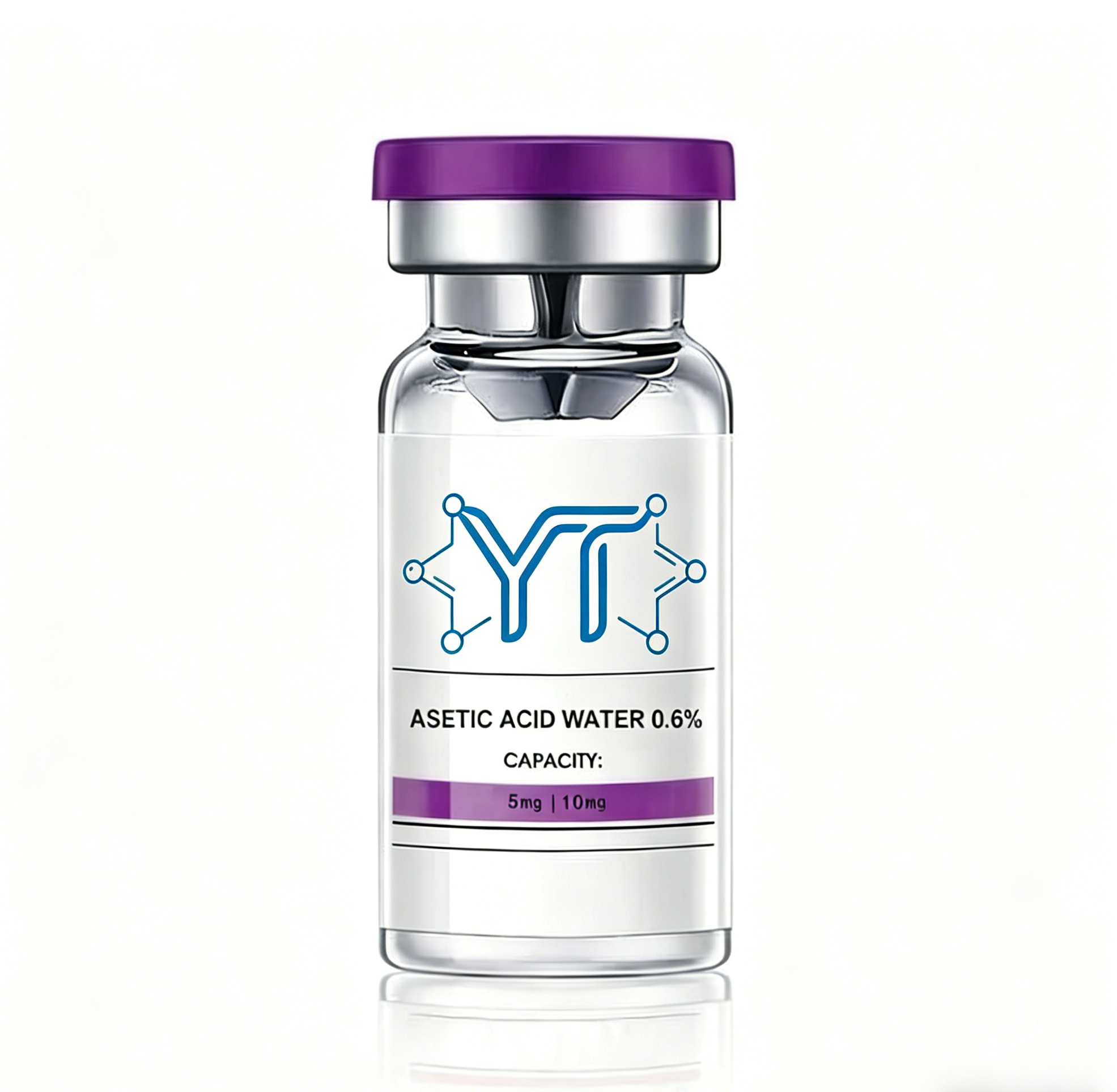
Acetic Acid Water (aqueous acetic acid/acetic acid water). In the field of peptide research, the most commonly used formulation is 0.6% sterile aqueous acetic acid solution (pH ≈ 3.0), a reagent specifically designed for the reconstitution of poorly soluble peptides. A professional and structured introduction is provided below from multiple dimensions:
I. Basic Information and Chemical Properties
Composition and Specification: Typically 0.6% (w/v) acetic acid dissolved in sterile water for injection; molecular formula CH₃COOH + H₂O. Acetic acid is a weak organic acid with a pKa of 4.76 (25°C), partially ionizing in water to render the solution acidic (pH ≈ 3.0).
Appearance: Colorless transparent liquid with a mild acetic acid odor.
Stability: Stable when stored sealed, cool and away from light; refrigerate after opening; do not subject to repeated high-temperature sterilization.
Note: "Asetic" is a spelling error of "Acetic". Distinguished from bacteriostatic water containing 0.9% benzyl alcohol (BAC Water, neutral pH ≈ 7.0).
II. Mechanism of Action (Core for Peptide Reconstitution)
Hydrophobic peptides with high isoelectric points (pI) tend to aggregate or gel in neutral water. 0.6% acetic acid water functions by:
Lowering the solution pH to well below the peptide's pI;
Protonating peptide molecules to carry a net positive charge;
The charge repulsion effect disrupts aggregation, enabling uniform dissolution, preventing gelation, and enhancing solution stability.
III. Application Scenarios and Usage
Applicable Peptides: High-pI peptides prone to aggregation such as AOD-9604, Frag 176-191; not suitable for GLP-1 lipidated peptides. Bacteriostatic water is preferred for conventional peptides.
Usage Method: First fully dissolve peptide powder in a small amount of acetic acid water until clear; then dilute to the target concentration with bacteriostatic water (balancing solubility and bacteriostasis).
Field: For laboratory research and peptide reagent preparation only; not for direct injection or consumption.
Common Packaging: 3ml and 10ml sterile vial packaging.


image

四、储存与安全

  1. 储存:未开封阴凉干燥处;开封后 2-8℃冷藏,尽快用完,避免污染;
  2. 安全:避免接触眼睛、皮肤黏膜;若接触用大量清水冲洗;酸性溶液不可与强碱混放;严格区分科研试剂与药用注射剂;
  3. 合规:仅用于研究,严禁临床或人体注射用途。

五、与抑菌水(BAC Water)对比

icon png
“Strength builds the foundation, and excellent services reach all over the world.”

create win-win situation with customers

We have cooperated with experienced shipping forwarders for many years, they arrange the shipment. No matter by express, by air or by sea, we will track the course of the goods all the way, to make sure goods arrive at you on time and in good condition.
GET A QUOTE

Related Products

Benzyl Alcoh

Benzyl Alcoh

Benzyl Alcohol is an important aromatic alcohol widely used in medicine, daily chemicals, food, chemical industry and other fields. The following is a detailed introduction: I. Basic Information Molecular Formula: () M ...
Acetic Acid Water

Acetic Acid Water

Acetic Acid Water is an acidic solution formed by dissolving acetic acid in water. It is one of the most common weak acid systems and is widely used in food, cleaning, chemical, pharmaceutical and other fields. ...
Adipotide

Adipotide

Adipotide (also known as FTPP, Prohibitin‑TP01) is a synthetic peptide targeting apoptosis in adipose blood vessels. Its core function is to selectively cut off the blood supply to white adipose tissue and induce ad ...

BENZYL ALCOHOL

BENZYL ALCOHOL

BENZYL ALCOHOL is an important aromatic alcohol widely used in pharmaceutical, daily chemical, food and industrial fields, renowned for its strong polarity, low toxicity and good solubility. Basic Information Molecular ...
Glutathione

Glutathione

Glutathione (GSH) is the most central and abundant endogenous antioxidant and detoxifying molecule in human cells, composed of glutamic acid, cysteine, and glycine, with its core activity derived from the sulfhydryl group (-SH). I. Basic Stru ...
Insulin

Insulin

Insulin is the only peptide hormone secreted by pancreatic β-cells in the human body that directly lowers blood glucose, and it is also a core drug for the treatment of diabetes. I. Basic Structure ...

HGH 191AA

HGH 191AA

HGH 191AA (Somatropin, Recombinant Human Growth Hormone) is a single-chain polypeptide consisting of 191 amino acids with an identical amino acid sequence to the naturally secreted human growth hormone. It is currently th ...

IGF‑1 LR3

IGF‑1 LR3

IGF‑1 LR3 (Long‑Arg³‑IGF‑1) is a synthetic long‑acting insulin‑like growth factor‑1 analog. Its structural modification has significantly enhanced its biological activity and ...

Hyaluronic Acid

Hyaluronic Acid

Hyaluronic Acid (HA, also known as hyaluronan; sodium hyaluronate in medicinal applications), covering its structure, sources, physiological functions, core applications, and molecular weight classification, suitable for ...
Kisspeptin

Kisspeptin

Kisspeptin is a core neuropeptide that regulates the reproductive system and serves as the "master switch" of the hypothalamic-pituitary-gonadal (HPG) axis. It also exhibits functions such as inhibiting tumor metastasis a ...
PNC‑27

PNC‑27

PNC‑27 is a chimeric anticancer cell-penetrating peptide. Its core characteristic is the selective recognition of HDM‑2 on cancer cell membranes, rapid formation of membrane pores leading to cancer cell necrosis, with almost no damage to normal ...

Sermorelin

Sermorelin

Sermorelin is a synthetic analogue of growth hormone-releasing hormone (GHRH). Its core function is to stimulate the pituitary gland to secrete endogenous growth hormone (GH), and it was once used i ...

ARA-290

ARA-290

ARA-290 (Generic Name: cibinetide) is a synthetic linear peptide consisting of 11 amino acids, modified from the B helix structure of EPO (Erythropoietin). Its core feature is that it retains the tissue-protective, anti-i ...