
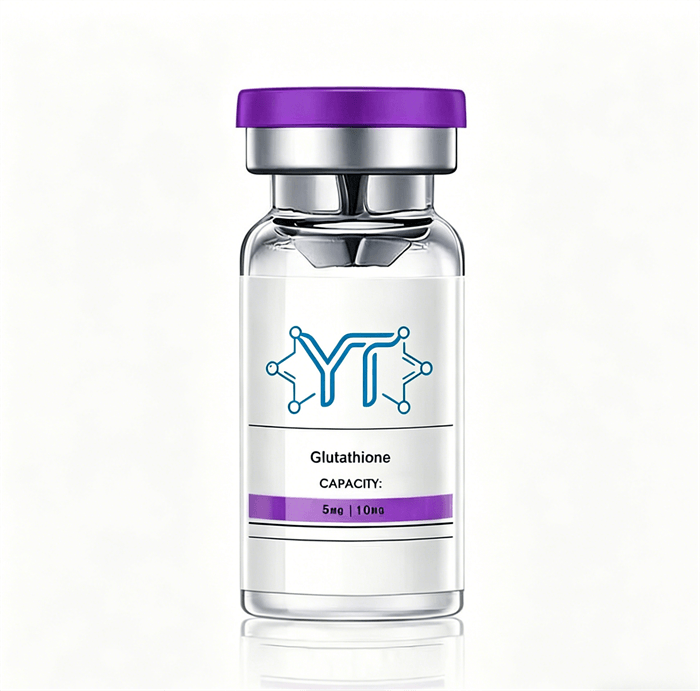
Glutathione
<
>
Glutathione

Glutathione


Product Description

Glutathione (GSH) is the most central and abundant endogenous antioxidant and detoxifying molecule in human cells, composed of glutamic acid, cysteine, and glycine, with its core activity derived from the sulfhydryl group (-SH).
I. Basic Structure and Forms
Chemical Nature: ¦Ã-L-glutamyl-L-cysteinyl-glycine (¦Ã-Glu-Cys-Gly), containing a ¦Ã-amide bond and a sulfhydryl group (-SH), with a molecular weight of approximately 307.
Two Forms:
Reduced Glutathione (GSH): The active form, accounting for more than 90% of the total intracellular content.
Oxidized Glutathione (GSSG): A dimer formed after GSH is oxidized, which can be reduced and regenerated by glutathione reductase.
Distribution: Present in almost all living cells, with the highest concentration in the liver, followed by the kidneys, red blood cells, eyes, and other tissues.
II. Core Physiological Functions
  1. Potent Antioxidation (Core Function)
    Direct free radical scavenging: The sulfhydryl group (-SH) donates electrons to neutralize superoxide anions, hydroxyl radicals, and lipid peroxides, protecting cell membranes, proteins, and DNA from oxidative damage.
    Regeneration of other antioxidants: Reduces oxidized vitamin C, vitamin E, and coenzyme Q10 back to their active forms, forming an antioxidant network.
    Maintenance of cellular redox balance: Regulates cell signaling, mitochondrial function, and protein folding.
  2. Liver Detoxification (Second Major Function)
    Toxin conjugation: Binds to drugs (e.g., acetaminophen), heavy metals (lead, mercury, arsenic), alcohol metabolites, and environmental toxins, converting them into water-soluble substances for excretion via bile or urine.
    Hepatoprotective effect: Clinically used for drug-induced liver injury, viral hepatitis, and alcoholic liver disease to repair liver cells and alleviate inflammation.
  3. Skin Whitening and Skin Health
    Inhibition of melanin production: Suppresses tyrosinase activity, reduces melanin synthesis, brightens skin tone, and fades dark spots.
    Anti-photoaging: Scavenges free radicals induced by ultraviolet radiation to protect skin cells.
  4. Immune and Metabolic Regulation
    Enhances the activity of immune cells, improving the body's ability to resist infection and eliminate pathogens.
    Participates in energy metabolism, amino acid transport, and inflammatory regulation, while maintaining mitochondrial function.

icon png
¡°Strength builds the foundation, and excellent services reach all over the world.¡±

create win-win situation with customers

We have cooperated with experienced shipping forwarders for many years, they arrange the shipment. No matter by express, by air or by sea, we will track the course of the goods all the way, to make sure goods arrive at you on time and in good condition.
GET A QUOTE

Related Products

Benzyl Alcoh

Benzyl Alcoh

Benzyl Alcohol is an important aromatic alcohol widely used in medicine, daily chemicals, food, chemical industry and other fields. The following is a detailed introduction: I. Basic Information Molecular Formula: () M ...
Acetic Acid Water

Acetic Acid Water

Acetic Acid Water is an acidic solution formed by dissolving acetic acid in water. It is one of the most common weak acid systems and is widely used in food, cleaning, chemical, pharmaceutical and other fields. ...
Adipotide

Adipotide

Adipotide (also known as FTPP, Prohibitin‑TP01) is a synthetic peptide targeting apoptosis in adipose blood vessels. Its core function is to selectively cut off the blood supply to white adipose tissue and induce ad ...

BENZYL ALCOHOL

BENZYL ALCOHOL

BENZYL ALCOHOL is an important aromatic alcohol widely used in pharmaceutical, daily chemical, food and industrial fields, renowned for its strong polarity, low toxicity and good solubility. Basic Information Molecular ...

Glutathione

Glutathione

Glutathione (GSH) is the most central and abundant endogenous antioxidant and detoxifying molecule in human cells, composed of glutamic acid, cysteine, and glycine, with its core activity derived from the sulfhydryl group (-SH). I. Basic Stru ...
Insulin

Insulin

Insulin is the only peptide hormone secreted by pancreatic ¦Â-cells in the human body that directly lowers blood glucose, and it is also a core drug for the treatment of diabetes. I. Basic Structure ...

HGH 191AA

HGH 191AA

HGH 191AA (Somatropin, Recombinant Human Growth Hormone) is a single-chain polypeptide consisting of 191 amino acids with an identical amino acid sequence to the naturally secreted human growth hormone. It is currently th ...

IGF‑1 LR3

IGF‑1 LR3

IGF‑1 LR3 (Long‑Arg³‑IGF‑1) is a synthetic long‑acting insulin‑like growth factor‑1 analog. Its structural modification has significantly enhanced its biological activity and ...

Hyaluronic Acid

Hyaluronic Acid

Hyaluronic Acid (HA, also known as hyaluronan; sodium hyaluronate in medicinal applications), covering its structure, sources, physiological functions, core applications, and molecular weight classification, suitable for ...
Kisspeptin

Kisspeptin

Kisspeptin is a core neuropeptide that regulates the reproductive system and serves as the "master switch" of the hypothalamic-pituitary-gonadal (HPG) axis. It also exhibits functions such as inhibiting tumor metastasis a ...
PNC‑27

PNC‑27

PNC‑27 is a chimeric anticancer cell-penetrating peptide. Its core characteristic is the selective recognition of HDM‑2 on cancer cell membranes, rapid formation of membrane pores leading to cancer cell necrosis, with almost no damage to normal ...

Sermorelin

Sermorelin

Sermorelin is a synthetic analogue of growth hormone-releasing hormone (GHRH). Its core function is to stimulate the pituitary gland to secrete endogenous growth hormone (GH), and it was once used i ...
ARA-290

ARA-290

ARA-290 (Generic Name: cibinetide) is a synthetic linear peptide consisting of 11 amino acids, modified from the B helix structure of EPO (Erythropoietin). Its core feature is that it retains the tissue-protective, anti-i ...