
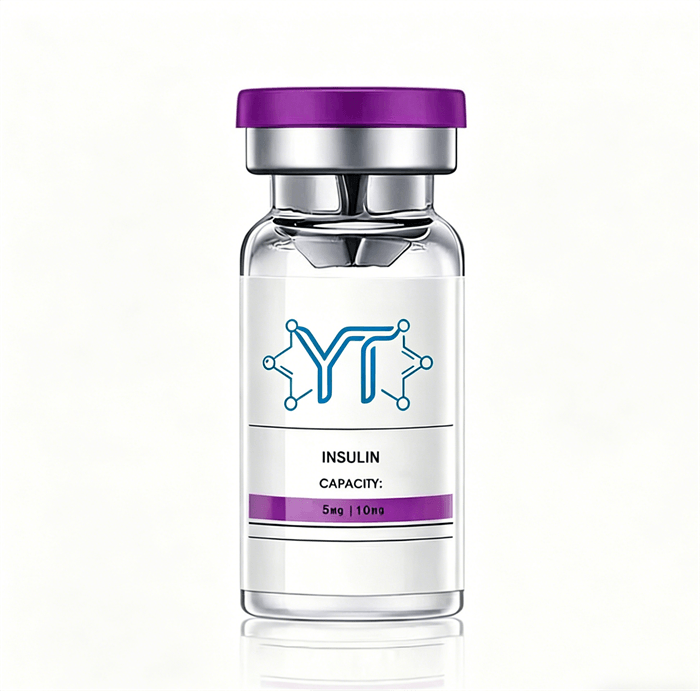
Insulin
<
>
Insulin

Insulin


Product Description

Insulin is the only peptide hormone secreted by pancreatic β-cells in the human body that directly lowers blood glucose, and it is also a core drug for the treatment of diabetes.

I. Basic Structure and Origin

Structure: Composed of an A-chain (21 amino acids) and a B-chain (30 amino acids) linked by two disulfide bonds, with a total of 51 amino acid residues.
Synthesis: Within pancreatic islet β-cells, preproinsulin is first synthesized, which is cleaved to form proinsulin, and then enzymatically digested into insulin and C-peptide (C-peptide can reflect the level of endogenous insulin secretion).
Nomenclature: Derived from the Latin word insula (island), as it is secreted by the islets of Langerhans.

II. Core Physiological Functions

Insulin is the major anabolic hormone in the body, regulating the metabolism of the three major nutrients:

Glucose Metabolism (Blood Glucose Lowering)

Promotes glucose uptake by muscle, adipose tissue, and the liver.
Stimulates the synthesis of hepatic glycogen and muscle glycogen, inhibits glycogenolysis and gluconeogenesis in the liver, thereby rapidly lowering blood glucose.

Lipid Metabolism

Promotes fat synthesis, inhibits lipolysis, and reduces ketone body production.

Protein Metabolism

Enhances amino acid uptake and protein synthesis, suppresses protein breakdown, and facilitates tissue repair.

III. Regulation of Secretion

Major stimulants: Elevated blood glucose (the most direct stimulus), gastrointestinal hormones after meals (such as GLP‑1, GIP), and vagus nerve activation.
Inhibitory factors: Decreased blood glucose, sympathetic nerve activation, glucagon, epinephrine, etc.
Secretory pattern: Sustained basal secretion + large postprandial pulsatile secretion to maintain blood glucose homeostasis.

IV. Classification of Clinical Preparations (by Duration of Action)

1. Ultrarapid / Rapid-Acting Insulin Analogues

Representatives: Insulin aspart, insulin lispro, insulin glulisine.
Characteristics: Rapid onset (10–15 minutes), high peak effect, short duration (3–5 hours).
Usage: Injected immediately before meals to control postprandial blood glucose.

2. Short-Acting / Regular Insulin (Human Insulin)

Representative: Regular (neutral) human insulin.
Characteristics: Onset 30 minutes after subcutaneous injection, peak at 1–3 hours, duration 4–8 hours.
Usage: Injected 15–30 minutes before meals; may be administered intravenously for diabetic ketoacidosis and hyperosmolar coma.

3. Intermediate-Acting Insulin

Representative: Isophane insulin (NPH).
Characteristics: Onset in 1–2 hours, peak at 4–12 hours, duration 18–24 hours.
Usage: Administered once or twice daily to provide basal insulin and control fasting blood glucose.

4. Long-Acting Insulin Analogues

Representatives: Insulin glargine, insulin detemir, insulin degludec.
Characteristics: Stable and peakless action, duration of 24 hours (up to 42 hours for insulin degludec).
Usage: Injected once daily at a fixed time for basal blood glucose control with low risk of hypoglycemia.

5. Premixed Insulin

Representatives: Insulin aspart 30/50, insulin lispro 25/50, human insulin 30R/50R.
Characteristics: A fixed ratio mixture of rapid-acting and intermediate-acting insulin, covering both postprandial and basal blood glucose control.
Usage: Injected once or twice daily before meals; must be thoroughly mixed before use.

V. Clinical Applications

Type 1 diabetes mellitus: Lifelong dependence on exogenous insulin (absolute deficiency).
Type 2 diabetes mellitus
  • Failure of oral antidiabetic drugs and poor glycemic control.
  • Acute complications (diabetic ketoacidosis, hyperosmolar coma).
  • Stress conditions such as severe infection, surgery, and trauma.
  • Gestational diabetes, impaired hepatic or renal function, and contraindications to oral medications.
Other uses: Correction of intracellular potassium deficiency (in combination with glucose and potassium chloride), diabetes caused by certain pancreatic diseases.

VI. Administration Routes

Subcutaneous injection: Abdomen, thigh, upper arm, buttocks (rotate injection sites to prevent lipohypertrophy / lipoatrophy).
Intravenous injection: Only short-acting insulin is used for emergency conditions (e.g., diabetic ketoacidosis).
Insulin pump: Continuous subcutaneous infusion to simulate physiological secretion, suitable for patients requiring precise glycemic control.

icon png
“Strength builds the foundation, and excellent services reach all over the world.”

create win-win situation with customers

We have cooperated with experienced shipping forwarders for many years, they arrange the shipment. No matter by express, by air or by sea, we will track the course of the goods all the way, to make sure goods arrive at you on time and in good condition.
GET A QUOTE

Related Products

Benzyl Alcoh

Benzyl Alcoh

Benzyl Alcohol is an important aromatic alcohol widely used in medicine, daily chemicals, food, chemical industry and other fields. The following is a detailed introduction: I. Basic Information Molecular Formula: () M ...
Acetic Acid Water

Acetic Acid Water

Acetic Acid Water is an acidic solution formed by dissolving acetic acid in water. It is one of the most common weak acid systems and is widely used in food, cleaning, chemical, pharmaceutical and other fields. ...
Adipotide

Adipotide

Adipotide (also known as FTPP, Prohibitin‑TP01) is a synthetic peptide targeting apoptosis in adipose blood vessels. Its core function is to selectively cut off the blood supply to white adipose tissue and induce ad ...

BENZYL ALCOHOL

BENZYL ALCOHOL

BENZYL ALCOHOL is an important aromatic alcohol widely used in pharmaceutical, daily chemical, food and industrial fields, renowned for its strong polarity, low toxicity and good solubility. Basic Information Molecular ...
Glutathione

Glutathione

Glutathione (GSH) is the most central and abundant endogenous antioxidant and detoxifying molecule in human cells, composed of glutamic acid, cysteine, and glycine, with its core activity derived from the sulfhydryl group (-SH). I. Basic Stru ...
Insulin

Insulin

Insulin is the only peptide hormone secreted by pancreatic β-cells in the human body that directly lowers blood glucose, and it is also a core drug for the treatment of diabetes. I. Basic Structure ...

HGH 191AA

HGH 191AA

HGH 191AA (Somatropin, Recombinant Human Growth Hormone) is a single-chain polypeptide consisting of 191 amino acids with an identical amino acid sequence to the naturally secreted human growth hormone. It is currently th ...

IGF‑1 LR3

IGF‑1 LR3

IGF‑1 LR3 (Long‑Arg³‑IGF‑1) is a synthetic long‑acting insulin‑like growth factor‑1 analog. Its structural modification has significantly enhanced its biological activity and ...

Hyaluronic Acid

Hyaluronic Acid

Hyaluronic Acid (HA, also known as hyaluronan; sodium hyaluronate in medicinal applications), covering its structure, sources, physiological functions, core applications, and molecular weight classification, suitable for ...
Kisspeptin

Kisspeptin

Kisspeptin is a core neuropeptide that regulates the reproductive system and serves as the "master switch" of the hypothalamic-pituitary-gonadal (HPG) axis. It also exhibits functions such as inhibiting tumor metastasis a ...
PNC‑27

PNC‑27

PNC‑27 is a chimeric anticancer cell-penetrating peptide. Its core characteristic is the selective recognition of HDM‑2 on cancer cell membranes, rapid formation of membrane pores leading to cancer cell necrosis, with almost no damage to normal ...

Sermorelin

Sermorelin

Sermorelin is a synthetic analogue of growth hormone-releasing hormone (GHRH). Its core function is to stimulate the pituitary gland to secrete endogenous growth hormone (GH), and it was once used i ...
ARA-290

ARA-290

ARA-290 (Generic Name: cibinetide) is a synthetic linear peptide consisting of 11 amino acids, modified from the B helix structure of EPO (Erythropoietin). Its core feature is that it retains the tissue-protective, anti-i ...